
3D Scanner
Professional / Education
Meticulously Detailed Art


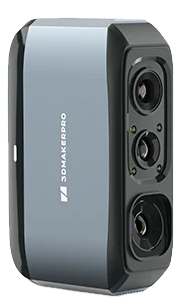
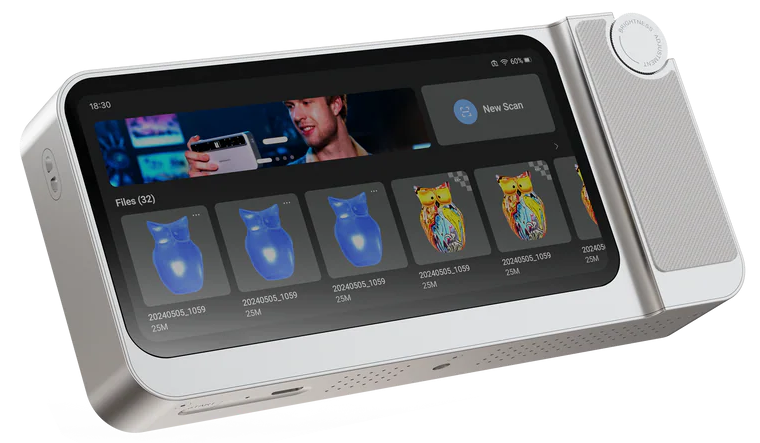
Professional and Educational 3D Scanners
Professional and educational 3D scanners are advanced tools that have transformed the way we capture, analyze, and visualize three-dimensional data. With exceptional precision and versatility, they allow the digitalization of objects, models, and complex environments, providing accurate results for industrial applications, academic research, and high-quality educational programs.
3D Scanning Technologies
3D scanners use advanced technologies tailored to each application:
- Laser scanning: captures complex geometries with high resolution and micrometer-level accuracy.
- Structured light scanning: ideal for medium-sized objects, fast acquisition, and precise modeling.
- Photogrammetry: digitalization through images, suitable for large objects and cultural or heritage environments.
Industrial Applications
Professional 3D scanners are essential in modern industry to optimize processes, reduce errors, and accelerate product development:
- Product design and prototyping: creating accurate digital models for engineering and manufacturing.
- Quality control and metrology: dimensional verification of parts to ensure manufacturing standards.
- Reverse engineering: reconstructing existing parts for redesign or additional production.
- Additive manufacturing: integration with 3D printers to produce prototypes and final parts.
Educational and Research Applications
In education, 3D scanners provide hands-on experience in digital modeling, design, and scientific analysis, enhancing learning at all academic levels:
- Schools and K–12: introduction to 3D technology and interactive projects for younger students.
- Universities and laboratories: advanced object and environment analysis, prototyping, and STEM research projects.
- Scientific research: detailed data capture in biology, archaeology, geology, and applied engineering.
Educational 3D scanners help students understand complex concepts in physics, engineering, mathematics, and design while developing practical skills in digital fabrication and data analysis.
Art and Cultural Heritage Applications
Beyond industry and education, 3D scanners are essential tools for art preservation and cultural heritage:
- Digitization of sculptures, artifacts, and historical objects.
- Creation of digital replicas for museums and educational centers.
- Analysis of deterioration and preservation through accurate 3D models.
Key Benefits of Professional and Educational 3D Scanners
- High precision and accuracy: detailed capture of complex geometries with minimal tolerance.
- Versatility: suitable for objects of varying sizes, materials, and environments.
- Efficiency and cost savings: reduces manual measurements, optimizes prototyping, and minimizes production errors.
- Software integration: compatible with CAD/CAM tools, 3D modeling, and scientific analysis software.
- Hands-on educational experience: practical and engaging for students of all levels, from K–12 to advanced research.
- Innovation and development: supports industrial, academic, and cultural projects that require accuracy and reliability.
Conclusion
Professional and educational 3D scanners are a strategic investment connecting industry, education, and research. Their precision, versatility, and ease of use allow users to explore, analyze, and create efficiently, fostering innovation, hands-on learning, and scientific research. Whether for engineering, academic labs, or educational programs, these scanners are essential tools for any project that requires high-quality 3D digitalization and modeling.