
3D Printer Pellets-Filament
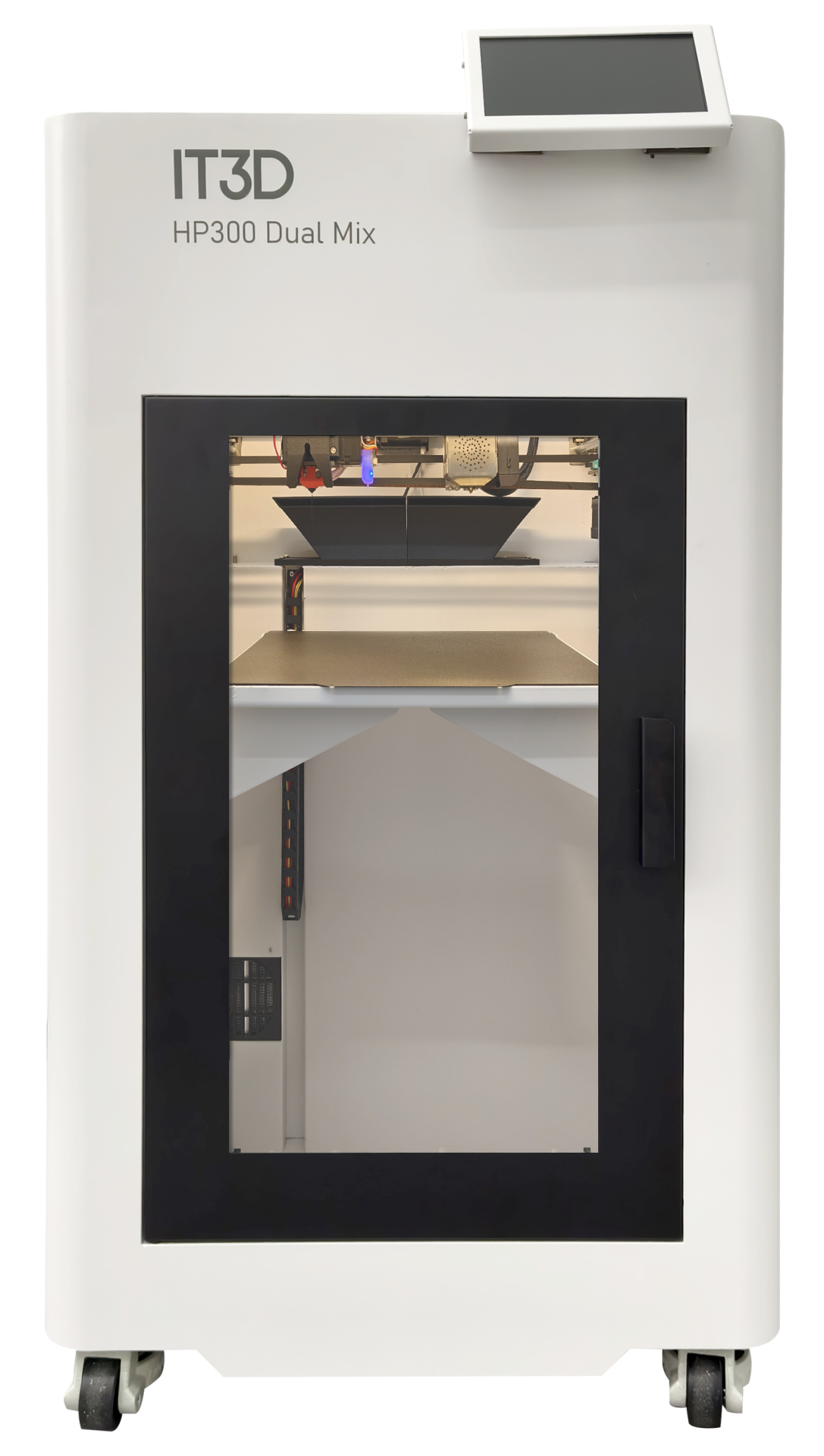
IT3D HP300 Dual Mix
IT3D HP300 Dual Mix
The IT3D HP300 Dual Mix Pellet-Filament printer is a professional large format 3D printer equipped with a double independent extruder: one for pellets and one for filament. This configuration offers unique versatility by taking full advantage of the benefits of each printing method, in a single additive manufacturing machine.
Thanks to its ability to print with pelletized pellet materials, including post-consumer recycled plastics, the IT3D HP300 Dual Mix printer is ideal for projects focused on circular economy and environmental sustainability. Its dual independent extrusion system optimizes production processes, allowing to work with a wide variety of technical and recycled materials.
With a print volume of 200 x 300 x 450 mm, enclosed design, and advanced features such as print resume after power failure, this 3D printer offers precision, reliability and efficiency. The IT3D HP300 Dual Mix not only ensures high-quality parts, but also drives responsible, innovative and cost-effective manufacturing.

Innovation in 3D Printing with Dual Extruders
The professional 3D printer IT3D HP300 Dual Mix Pellet-Filament represents a technological leap in the world of additive manufacturing. Designed for 3D printing with simple, advanced and recycled materials, this 3D printer stands out for its unique double independent extruder system, which allows working simultaneously with pellets and filamentin the same equipment. This flexibility makes it the ideal tool for research centers, production and projects focused on the circular economy.
This 3D printer not only improves production processes, but also reduces environmental impact through the use of reused materials, aligning with the principles of industry 4.0 and the circular economy.
High Performance Ceramic Materials
The IT3D HP300 Dual Mix allows the use of ceramic-filled materials, ideal for advanced research and development
Advantages of the Pellet Extruder
- Handling of complex materials: Compatible with a wide range of technical materials such as Inox 316L, PA12 30% CF, PC+20% CF, PEKK CF, PC-PTFE and many more.
- Sustainability and circular economy:It allows working with post-consumer recycled plastics, favoring the reuse of waste and reducing the environmental impact in the manufacturing processes.
- Maximum nozzle temperature: 300 ºC, allowing the extrusion of high-performance technical materials.
- Double temperature control: Guarantees uniform melting of the material, improving the adhesion between layers and the final quality of the parts.
- Adjustable nozzles: Available diameters of 0.4 mm, 0.6 mm, 0.8 mm, 1.0 mm and 2.0 mm, adapting to different applications.
Advantages of the Filament Extruder
- High printing precision: Layer height of up to 0.05 mm, allowing parts with great level of detail.
- Maximum temperature of 500°C: Compatible with advanced materials in filament format.
- Printing speed: Up to 300 mm/s, optimizing productivity.
- Wide material compatibility: PLA, ABS, TPU, PETG and other thermoplastics common in 3D printing.
- Interchangeable nozzles: Available in 0.2 mm, 0.4 mm, 0.6 mm and 0.8 mm to suit different resolutions and printing needs.
- Filament end sensor: Detects lack of material in the filament extruder and pauses printing to avoid failures.
From Waste to Resource:
The 3D Printer for the Circular Economy
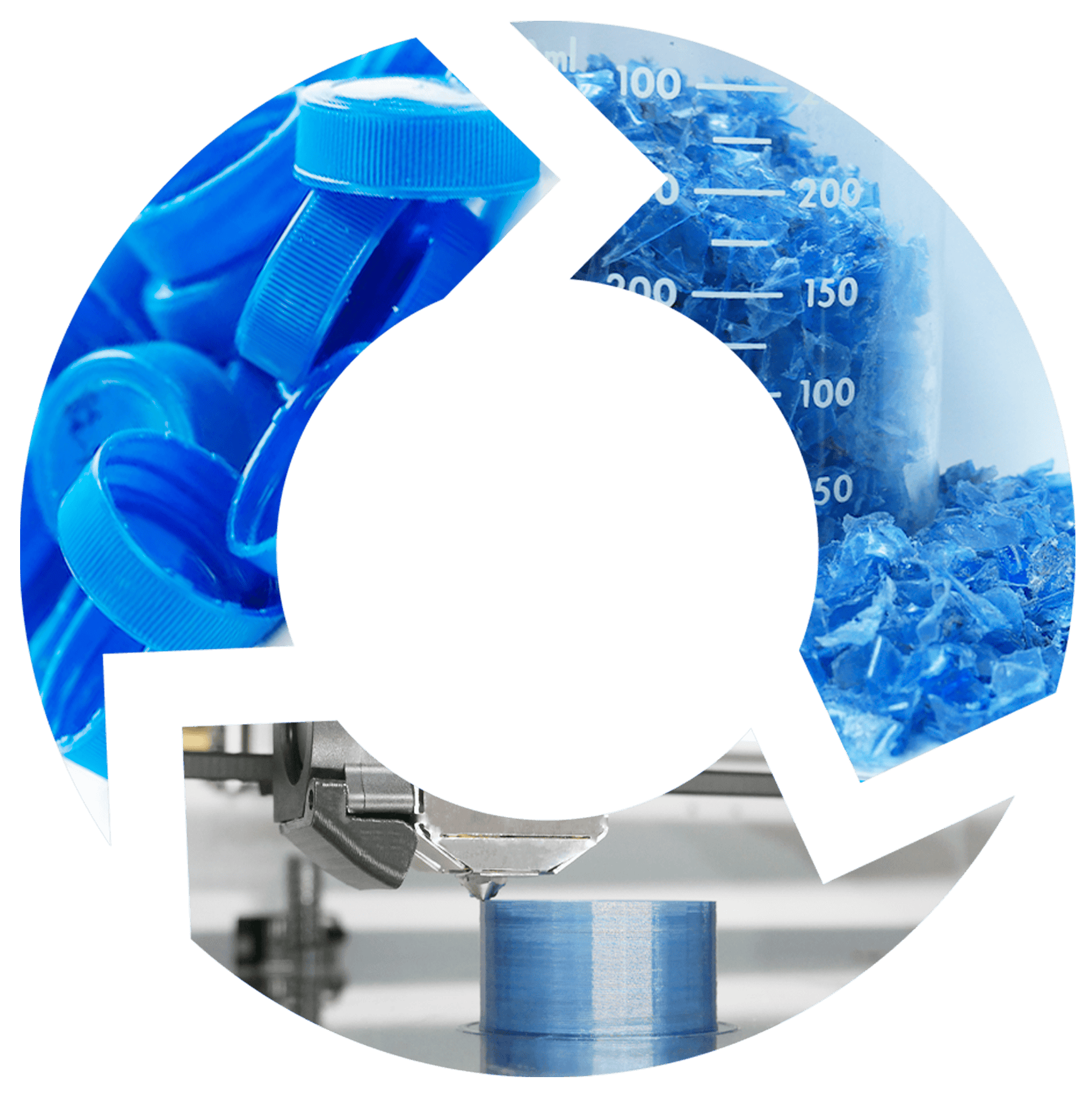
The IT3D HP300 Dual Mix Pellet-Filament is an additive manufacturing platform focused on the valorization of recycled materials in 3D printing processes. This system enables the direct extrusion of plastics in flake or pellet form, allowing for the reuse of post-consumer waste as technical raw material, without requiring prior conversion into filament.
Thanks to its ability to process non-standard and recycled materials, the P300 is an effective tool for circular economy strategies applied to additive manufacturing. Its architecture is designed to integrate into technical recycling processes, promoting the reduction of environmental impact associated with plastic use, while enabling a scalable, efficient, and responsible production in terms of material use.
This approach not only allows for the direct use of plastic waste, but also advances research and optimization of new recycled or hybrid materials for industrial and sustainable development applications.
Reduction of environmental impact
Transforms plastic waste into new products.
Circular Economy
Circular Economy
Efficient production
Less waste of resources, higher productivity.
Compatibility with advanced materials
Compatibility with advanced materials
Sustainability
Contribute to a greener future by reusing materials.
Scalability
Ideal for large parts or series where the filament does not yield.
IT3D HP300 HP300 Dual Mix Pellet - Filament Highlights
- Hot bed temperature up to 120 °C: Improves part adhesion, especially when printing with technical materials and recycled plastics.
- Printing volume: 200 x 300 x 450 mm, allowing the manufacture of large parts.
- Automatic base leveling: Guarantees accurate printing from the first layer, reducing errors and setup time.
- Flexible magnetic base: Facilitates the removal of parts without damage, improving efficiency and reducing the risk of breakage.
- 7-inch LCD touch screen: Intuitive interface that allows full control of the print parameters in real time.
- Advanced connectivity: Compatible with Wi-Fi, Ethernet and USB, ideal for collaborative work environments or networked production.
- Integrated camera: For real-time monitoring of printouts.
Technical Specifications
| Feature | Details |
|---|---|
| Printing Technology | FDM + FGD |
| Printing Volume | 200 x 300 x 450 mm |
| Print volume copy | 150 x 300 x 450 mm |
| Printing volume Mirror | 100 x 300 x 450 mm |
| Layer Height | Pellet: 0.1 – 1 mm | Filament: 0.05 – 0.5 mm |
| Max. Operating Speed | Pellet: 180 mm/s | Filament: 300 mm/s |
| Accuracy | 0.2 mm |
| Compatible Materials | PLA, ABS, TPU, PETG, etc. |
| Nozzle Diameter | Pellet: 0.4 – 0.6 – 0.8 – 1 mm | Filament: 0.4 – 0.6 – 0.8 – 1 mm |
| Number of Extruders | 2 (Pellet – Filament) – 100% independent |
| Heated Chamber | By air fan (max. 60º) |
| Heated Bed Temperature | Max 120 ºC |
| Nozzle Temperature | Filament: Máx. 500 ºC – Pellets: Máx. 300 ºC |
| LCD Screen | 7-inch color touchscreen |
| Filter | HEPA H13 and activated carbon (99.95% of particles) |
| Slicing Software | Cura Slicer |
| File Formats for Slicing | STL, OBJ, Gcode |
| Connectivity | Ethernet cable, Wi-Fi, USB |
| Rated Voltage | 100-120V / 200-240V / 50-60 Hz |
| Output Voltage | 24 V |
| Rated Power | 270 W |
| Built-in Camera | Yes |
| Weight | 60 kg |
| Calibration | Automatic |
| Platform | Flexible magnetic bed |
| 3D printer dimensions | 560*510*1020 mm |
| 3D printer weight | 75 kg |
| Weight of 3D printer with packaging | 98.5 kg |
| Operating System | Windows 7 or higher, MAC OS, Linux |
| Fully Enclosed Structure | Yes |
| Resumption of printing after power failure | Yes |
| Filament Run-Out Detection | Yes |
| Extruder with Dual Temperature Control | Yes |
IT3D LEARNING
Course: Introduction to Pellet-Based 3D Printing
Develop practical expertise in direct pellet extrusion, focusing on material preparation, screw-driven flow regulation, and process optimization. This course is tailored for professionals aiming to adopt high-throughput additive manufacturing using thermoplastic pellets across diverse industrial and research applications.
Core Modules
- Module 1: Fundamentals of Pellet-Based 3D Printing (FGD)
- Module 2: Pellet Extruder – Components and Operation
- Module 3: Process Parameters and Application Cases
- Module 4: Materials for Pellet Extrusion
Specialization Modules
- Module 1: Circular Economy and Sustainable Manufacturing
- Module 2: 3D Printing with Ceramic Materials
- Module 3: Metal-Based Additive Manufacturing Using Pellets
- Module 4: Biopolymers and Eco-Friendly Alternatives